Daily Edition · 7 min readFree. New issue every weekday morning, lighter on weekends.

CRE Blurb: Thursday, November 19, 2026

The daily commercial real estate briefing for students and professionalsDaily CRE briefing for students

The Brief

  1. Office loans bundled into bonds are souring at a record pace, squeezing building owners. Connect CRE
  2. A closely watched industry survey shows sentiment sliding as high rates freeze dealmaking. Connect CRE
  3. Fewer buyers signed home contracts in October, a warning sign for housing demand. National Association of REALTORS®

Market Snapshot

10-Year Treasury
5.07%-3 bps
Benchmark for long-term property loans
SOFR
3.90%-2 bps
Base rate for floating-rate property loans
Real estate stocks (VNQ)
$95.18+0.3%
A fund holding about 150 REITs

Rates as of Nov 18 close. Full market data

Top Story

Office CMBS Delinquencies Hit a Record

Fitch Ratings' overall U.S. CMBS delinquency rate rose to 3.60% in October from 3.46% in September, driven by a wave of new defaults led by office. The office delinquency rate reached an all-time high of 9.33%, beating the prior record.

Source: Connect CRE: Office CMBS Delinquencies Hit a Record

Why it matters When office loans inside these bonds stop paying, bondholders lose income and lenders grow wary, making it harder and pricier for any office owner to refinance.

Industry Sentiment Slips as Deals Stall

The Real Estate Roundtable's Q4 2026 Sentiment Index fell 10 points to 53, as higher interest rates and geopolitical uncertainty pushed investors to hold off on deals. The Current Index dropped 16 points to 47, even as property operations stayed healthy across most sectors.

Why it matters: sentiment surveys track how willing large investors are to buy and sell, and a drop means fewer transactions, which slows price discovery and leaves sellers waiting.

Source: Connect CRE: Industry Sentiment Slips as Deals Stall

A Korean Fund Warns an AI Credit Event Could Spread

A large South Korean fund said it plans to trim its real estate holdings and warned that a credit problem tied to AI lending could ripple into other markets. A credit event is when a borrower defaults or a loan sours badly enough to rattle investors.

Why it matters: if a major global investor pulls back from property, it removes a buyer from the market and can drag values lower for everyone still holding.

Source: Markets Group: A Korean Fund Warns an AI Credit Event Could Spread

Coffee chat talking points

Talking points you can use in networking conversations

  1. With the office CMBS delinquency rate hitting a record 9.33%, it makes sense the Roundtable's sentiment reading is sliding. Connect CRE
  2. Pending home sales falling 4.7% in October shows the demand softness isn't just a commercial story, it's reaching housing too. National Association of REALTORS®

Debt Markets

Higher borrowing costs could stall the rebound in CMBS issuance expected in 2027, according to CoStar. CMBS (commercial mortgage-backed securities) are bonds backed by pools of property loans, and when lenders and bond buyers demand higher yields, new deals get harder to pencil. CoStar

Why it matters: fewer new CMBS deals mean less fresh financing for owners who need to refinance loans coming due.

A $250 million CMBS loan on 101 Hudson Street, a 1.4 million-square-foot Jersey City office tower, was sent to special servicing after missing its October maturity. Special servicing is where troubled loans go to be worked out or headed toward foreclosure. Commercial Observer

Why it matters: another large office loan in trouble pushes lenders to tighten terms on similar buildings, raising costs for every office borrower.

Servicers have modified nearly $100 billion of CMBS loans since 2022, but one in five dollars from those fixes is delinquent again, Trepp reports. Modifying a loan means changing its terms to buy the borrower time. Trepp

Why it matters: if workouts keep failing, lenders may stop offering them, pushing more struggling owners toward foreclosure or sale.

A $140 million commercial mortgage-backed securities (CMBS) loan tied to 123 William Street, a 27-story office tower in Manhattan's Financial District, has entered special servicing. Occupancy fell sharply, pushing the building below break-even, and its owners face bankruptcy risks. Special servicing means a troubled-loan specialist now handles the debt, according to Commercial Observer.

Why it matters: CMBS loans are bundled and sold to bond investors, so when a big office building stops earning enough to cover its debt, those investors can lose money and lenders grow warier of other shaky office towers.

Distress Watch: The Real Deal looks at a lender taking control of 12 distressed New York buildings and asks what a lender actually wants with a troubled portfolio. The Real Deal

Market Watch

Sun Belt

Dallas-Fort Worth developers are pushing industrial projects beyond the metro's established core as they chase cheaper land, Bisnow reports. DFW is already one of the nation's top warehouse markets, and the growth is spreading to outlying areas. Bisnow

Why it matters: cheaper land on the edges lets developers build warehouses at rents tenants can still afford, helping DFW keep winning logistics tenants.

West Coast

A San Diego investor paid $51 million for a Woodinville industrial park outside Seattle, according to The Business Journals. The out-of-state buyer stepped in for a suburban warehouse and flex-space complex. The Business Journals

Why it matters: out-of-state buyers paying up for industrial parks signals they still see steady demand for warehouse space around Seattle.

International

The Cerberus-backed company behind London's Battersea Glassmill tower is being liquidated after a failed planning bid and local opposition, Bisnow reports. The project was held in an SPV, a company set up to own one development. Bisnow

Why it matters: when a single-project company collapses, its lenders and investors can lose money, a reminder that failing to win planning approval can sink a development.

Quick Hits

  • Asheville's commercial vacancies hit a 10-year high following Hurricane Helene. WLOS When a disaster drives businesses out, empty storefronts pile up and landlords struggle to fill them.
  • Private equity owners are slower than REITs to mark their CRE portfolios to current market values. Bisnow Private appraisals can lag reality, so some owners may be carrying buildings at prices buyers will not actually pay.
  • Boston's City Council voted to eliminate parking minimums for new housing. Bisnow Dropping required parking spaces cuts construction costs, which can make apartments cheaper and quicker to build.
  • New York City's Mamdani administration is suing Bronx landlords, claiming unpaid fines amount to fraud. Bisnow Aggressive enforcement raises the stakes for owners who ignore city penalties.
  • Medipower bought a 16-property grocery-anchored portfolio in Pennsylvania for $275 million. Bisnow Grocery-anchored centers draw steady foot traffic, which keeps investors interested even when other retail struggles.

The Numbers

Every number is filled in automatically from public data.

Rates

10-Year TreasuryBenchmark for long-term property loans
5.07%-3 bps
5-Year TreasuryBenchmark for many 5-year commercial mortgages
4.89%-1 bps
2-Year TreasuryTracks where the Fed is expected to set rates
4.80%0 bps
10Y-2Y curveNegative = short-term rates above long-term, often a slowdown signal
27 bps-3 bps
SOFRBase rate for floating-rate property loans
3.90%-2 bps
Fed FundsThe Fed's target for overnight bank lending; other rates key off it
3.75% to 4.00%0 bps
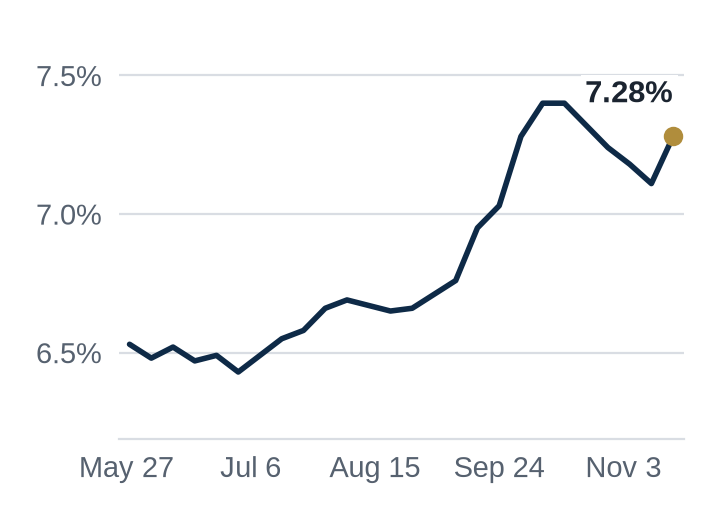
30-Year Mortgage30-year home mortgage rate (Freddie Mac); a housing-demand gauge, not a CRE loan rate (as of Nov 19)
7.28%+17 bps

Rates as of Nov 18 close.

Line chart of the 10-Year Treasury yield, from 5.27% on Oct 6 to 5.07% on Nov 18.
10-Year Treasury yield, last 45 days.
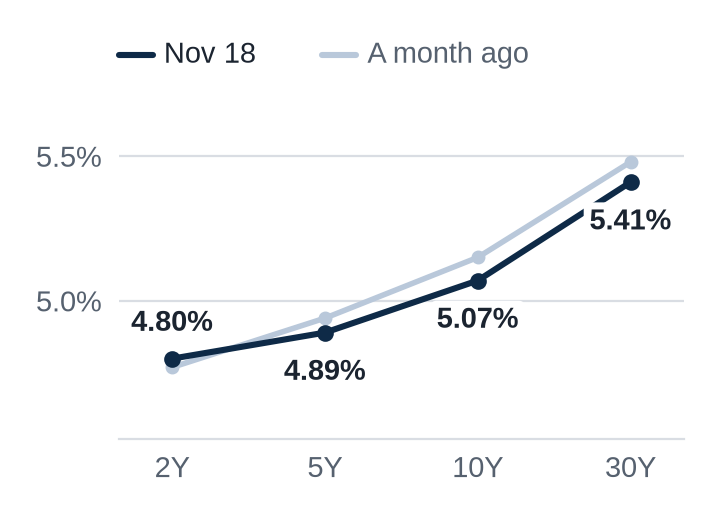
Line chart of Treasury yields by maturity. On Nov 18: 2Y 4.80%, 5Y 4.89%, 10Y 5.07%, 30Y 5.41%. A month ago (Oct 19): 2Y 4.77%, 5Y 4.94%, 10Y 5.15%, 30Y 5.48%.
Treasury yields by maturity, latest close vs. a month ago. Upward slope = longer loans cost more.
Line chart of the 30-year mortgage rate over the last six months, from 6.53% on May 28 to 7.28% on Nov 19.
30-year mortgage rate, last six months (Freddie Mac).

Federal Reserve

FOMC: next Fed meetingWhen the Fed next decides on rates
Dec 9
Odds of a cutChance rates go down. Prediction-market odds from Polymarket traders
0.4%
Odds of a holdChance rates stay the same
2.5%
Odds of a hikeChance rates go up
97.1%

Kalshi: hold 3.4%

Stacked bar of prediction-market odds for the Dec 9 Fed meeting: cut 0.4%, hold 2.5%, hike 97.1%.
What prediction markets expect at the next Fed meeting. Odds as of Nov 19.

REITs

Real estate stocks (VNQ)A fund holding about 150 REITs
$95.18+0.3%
Biggest gain todayOwns Los Angeles and Honolulu offices and apartments
Douglas Emmett (DEI)+1.9%
Biggest drop todayOwns West Coast offices and studios
Hudson Pacific Properties (HPP)-6.5%
REIT dividend yieldYearly income per $100 invested in VNQ
3.63%
REIT yield vs. 10-Year TreasuryBelow zero: Treasuries out-yield REIT dividends, so REITs look pricey vs. bonds
-144 bps
Bar chart of moves for the Nov 18 close for 17 REITs, best to worst: DEI +1.9%, ADC +1.8%, BXP +1.8%, STAG +1.4%, ESS +1.1%, DLR +1.0%, EQIX +0.7%, VNO +0.6%, WELL +0.6%, SPG +0.5%, O +0.4%, NNN +0.3%, UDR 0.0%, PLD -0.3%, VICI -0.5%, MAA -0.7%, HPP -6.5%.
Daily move, Nov 18 close, for the REITs we track. Shows which property types had a good day.

What it means: Treasury yields held roughly steady, but the 30-year mortgage rate jumped, which raises monthly costs for homebuyers and keeps pressure on housing demand.

Why Douglas Emmett (DEI) moved: the owner is in a public rent fight, suing SoulCycle over unpaid rent at a Santa Monica space, a reminder that even well-located landlords are chasing tenants for payment. The Real Deal

Why Hudson Pacific Properties (HPP) moved: No company-specific news today; it may have moved with other office REITs.

Term of the Day

Price per square foot

A building's sale price divided by its total size. It lets buyers compare deals of different sizes on equal footing. If a $10 million building holds 100,000 square feet, that is $100 per square foot. A nearby building selling for more per foot is pricier for the same amount of space.

Data Room

Slower-moving credit data. Rows marked Updated changed since the last issue.

High-yield spread UpdatedExtra interest risky companies pay over Treasuries; higher = lenders more nervous
3.47%+4 bps
Bank CRE loans (Nov 4)Total commercial property loans banks hold
$3,158B+0.1%
Bank CRE delinquency (Q2 2026)Share of banks' commercial property loans that are behind on payments
1.53%-3 bps
CMBS delinquency (Oct 2026)Share of commercial property loans in bonds that are behind on payments
7.87%-15 bps

Data checks: REIT prices came from a single source today. Treasury yields matched across FRED and Treasury.gov. Fed odds in line with Kalshi.

New issue every morning at creblurb.org.